Twenty-five years in the security industry teaches you to recognize patterns nobody else sees—and the biggest one is that the entire field has been optimizing for failure.
When a business partner first presented the observation that the entire security field was missing something fundamental—a spotlight instead of a floodlight, something that moves and responds instead of just washing light passively across an area—the pattern became impossible to ignore. The industry had been speaking in past tense without realizing it.
Every security conversation assumes the crime will happen and optimizes for what comes after—faster alerts, clearer footage, quicker response times, all improvements to a fundamentally failed premise.
By the time you’re responding, the damage is done.
The Industry Optimized Everything Except the Crime Itself
The entire field focused on making passive systems better and better and better—more storage, smarter cameras, cloud monitoring, AI-enhanced analytics—all mechanical improvements to equipment that sits around doing nothing except recording.
Here’s what the industry wasn’t talking about.
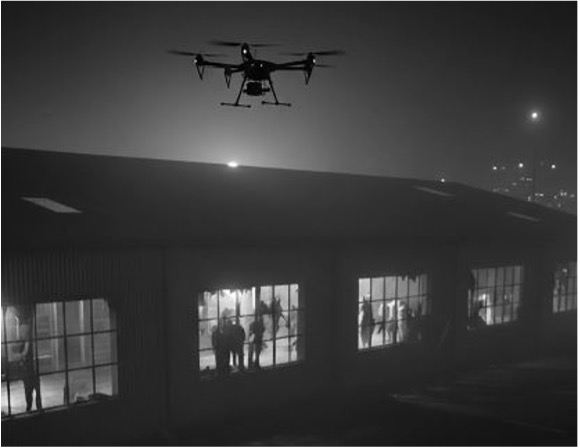
The fundamental problem is the crime itself, not how well it gets documented. Where you could see people thinking forward was only with drones—which is strange when you analyze it—the industry focused on identifying drones and stopping drones mid-flight, but nobody was talking about identifying criminals on their way to commit a crime and stopping them. Drones represent a tiny percentage of overall crime statistics, yet that’s where intervention thinking went.
This reveals something deeper about how the industry thinks—it’s almost as if people are untouchable, even criminals, whereas drones are not. There’s an unspoken boundary where the industry treats human intervention as somehow off-limits while technology intervention is acceptable.
Passive Deterrence Became the Ceiling Instead of the Floor
Better passive security is a step up from no passive security, and any system that can deter a person is an improvement—but they don’t deny.
The improvements have always been mechanical—more storage, better storage systems, smarter cameras. If a criminal sees a camera, it can be anything from a $50 dummy camera all the way up to the most expensive artificial intelligence-driven camera in the world and they can’t tell the difference. If it deters them, that’s a win. But if it doesn’t, you’ve spent all that money improving a system that can’t actually stop anyone.
Studies show visible cameras deter 53% of burglars—which means nearly half proceed despite being recorded. The other 47% have already done the math and decided the footage doesn’t matter. The industry built a four-hundred-billion-dollar ecosystem around documenting failure instead of preventing it.
From the criminal’s perspective, a $50 dummy camera and a $50,000 AI system look identical—and if neither one stops them, the investment was irrelevant.
Watching the industry pour resources into that distinction for decades reveals something important—the innovation was actually serving the manufacturers and the security decision-makers who needed to justify increased costs, not the people trying to prevent crime.
The Language Reveals How the Industry Actually Thinks
Every term the industry uses assumes the crime completed—captured footage, recorded incident, post-event analysis. This isn’t accidental. It’s how the field thinks. Traditional camera systems are passive—they record, they don’t react. The entire reactive security framework activates only after loss has occurred, which means organizations are optimizing how quickly they can assess what they’ve already lost.
The pattern shows up everywhere once you start looking for it—nobody was talking about active security at all. It was year after year of trying to build better passive systems.
When you talk to someone who’s experienced a break-in despite having cameras and alarms, they usually say some variant of the same thing—I put all of this money into a security system and yet a crime was still committed and I still lost these things and this amount of money. The system “worked” in the technical sense—it recorded, it alerted, maybe even helped catch the person later—but from their perspective, it failed.
A crime committed is a crime that has incurred significant cost.
The industry optimized everything that happens after that cost is already paid—and there’s no guarantee you’re going to find the criminal anyway.
The Ethical Line Nobody’s Defining
When you start developing active intervention systems, you have to draw a line most people in the industry haven’t even considered yet.
You can’t have a system that’s going to actually cause physical damage to a person, and you have to have a system that’s capable of being specific enough that it can tell the difference—or be directed to the difference—between a non-criminal and a criminal.
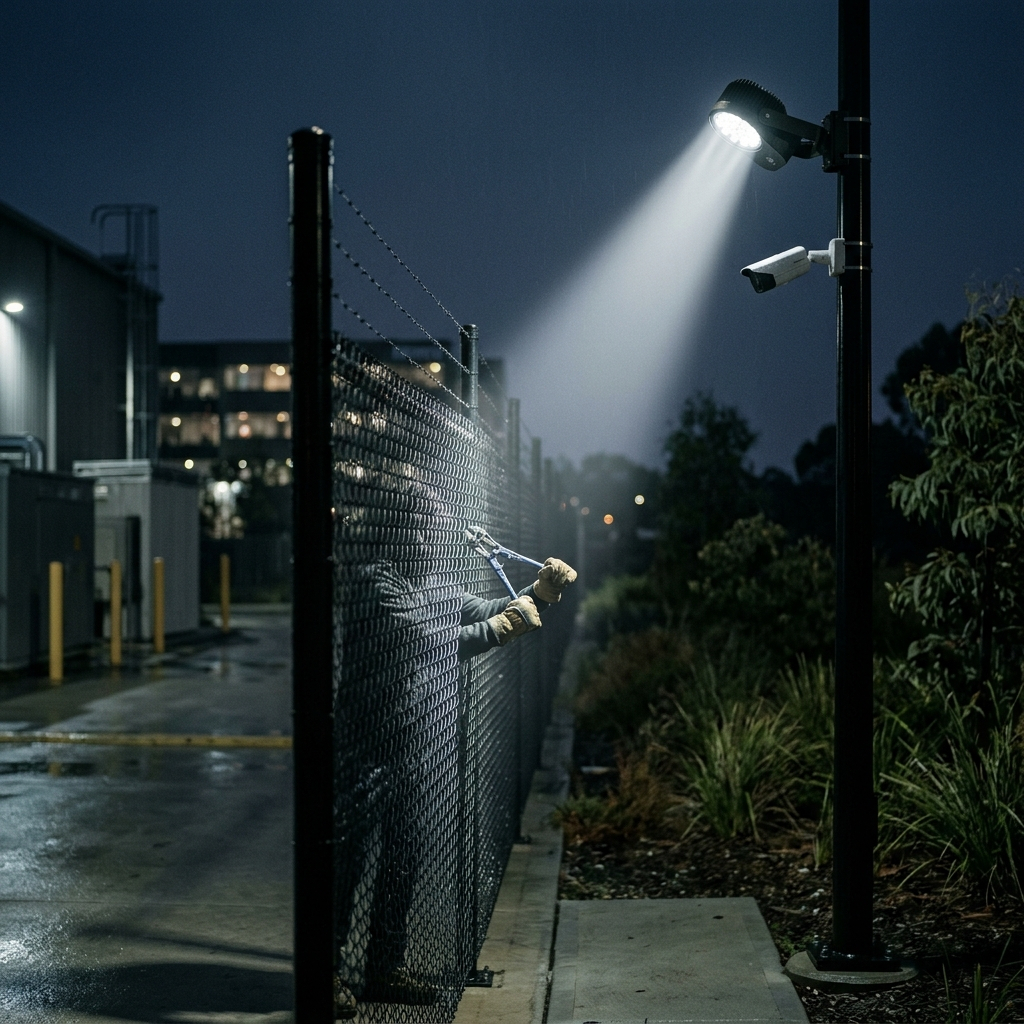
If there’s a bad guy trying to break in at your fence line and you accidentally shine this bright light into a car window for a family driving by, that’s not a very good system—so you have to constantly remind people that light is non-lethal and non-damaging but can still deny criminals access.
The line in the sand in civilized countries is always the same—you can’t actively hurt the person trying to commit a crime.
Precision became the ethical requirement—you can intervene, but only if you can be specific enough to affect the criminal without impacting innocent people nearby.
Here’s the problem with that requirement—in our current environment, precision and stopping a crime against a person is done by someone with a firearm. You’ve got bad guys trying to commit a crime and the police are there in time to point their guns at the criminals and say stop. But outside of that, there isn’t a specific case where an AI-driven or mechanical system has stopped someone in an active way—not a passive way where they couldn’t climb the fence, but an active way.
This is building toward something that doesn’t exist yet—a category between passive barriers and lethal force that the industry hasn’t even named.
Decision-Makers Are Asking the Wrong Questions
When talking about IntelliLight—the product developed at Luminous Pillars—with decision-makers, the first question they ask is usually “how does it work,” which almost always comes right after they say “no one has thought of this before.”
What they really want to know is how it stops a criminal from committing a crime—how can it help me protect critical infrastructure, how can it target a person without hurting a bystander. What they’re really saying is what a great idea, and immediately I can see how it would work for me, but tell me how it would work for me specifically.
They can immediately see the application, which means the gap was obvious once someone named it.
But for 25 years, nobody named it.
The challenge isn’t convincing people active security is better—it’s getting them to realize the category exists at all. People have a tendency to say I spent $100,000 on my security system, I don’t want to spend more, but active security is an add-on to the passive security system—you don’t have to throw anything away, and this product is not nearly as expensive as some of the ones you’ve already chosen.
The fundamental shift is this—what your system should do first and foremost is deny criminals access to whatever it is they’re trying to steal or destroy.
It’s no different than the defensive side of the football team trying to stop the offense from scoring—the defense isn’t just looking to make sure the other team takes forever to score or trying to deter them from scoring so they wait for halftime. The goal is to stop them. Nobody celebrates a defense that just watches the other team score while recording great footage.
Fight Back Is the Language That Changes Everything
Passive—the definition is standing around doing nothing. What does a camera do—it sits around and does nothing except record.
When the marketing started, there was some concern about using such aggressive words, but that’s the only solution.
Strong, active verbs. Powerful statements. Fight back against crime. Stop people from committing crime. Stop crime before it starts. Why are we being passive—we should fight back.
The shift from passive to active verbs isn’t stylistic—it’s ideological. If the industry speaks passively, it will think passively. Change the language, change the mindset.
There’s not much resistance to this idea—there are always the security dinosaurs who like the things they have and don’t ever want to change, but generally speaking, resistance isn’t the problem.
What’s needed is market awareness—taking every opportunity to start the thought leadership process of moving from only passive to active security. It’s not resistance. It’s lack of awareness.
What Comes After Active Intervention Becomes Standard
What happens when active intervention becomes as commoditized as cameras are now is worth considering, even though it’s not the immediate focus.
It layers—humans, drones, then you start looking at the different types of active security systems that could be used. Light, sound, maybe heat or something similar. You have to mature the different versions of active security—the different things that can serve the role that are not humans. And then you have to get ever better at identifying the bad guy.
If a person is planning to destroy a Tesla charging station, somewhere down the road we have to be able to visually identify whether or not the person is holding bolt cutters or a cane—there’s algorithmic work and identification work that needs to come in. But that’s not even the current focus simply because the security industry as a whole has to recognize the need for active security systems first.
The product being brought to market in the commercial space—non-military—is the first such product in the market as far as we can tell.
This isn’t just selling a product—it’s shifting the entire industry’s language from passive observation to active opposition.
The Shift That Has to Happen
Passive systems don’t deny criminals—they deter them. There’s a fundamental difference.
The more data and detail you can give to law enforcement and prosecutors, the better—but it still doesn’t change the fact that a crime committed is a crime that has incurred significant cost, and there’s no guarantee you’re going to find the criminal.
The security industry needs to move toward denying criminal access—not documenting it, not responding faster to it, stopping it before it starts.
This is the missing layer between passive barriers and lethal force—it adds the capability passive systems can’t provide without eliminating what they do well.
Twenty-five years of watching this industry speak in past tense makes it easier to recognize when it starts to realize what it’s been missing.
The conversation is changing. The language is shifting. Decision-makers are starting to ask what if we could stop it before it starts.
That’s the question the industry should have been asking all along.